
Continuity
UC Riverside Continuity Planners collaborate with faculty & staff to increase the University’s resilience in the face of disruptive events. By building resilience, these dedicated planners work to ensure the University can continue its mission of teaching, research, public service, and patient care during any disruptive event and return to normal performance as quickly as possible. An important aspect of this work is developing a continuity plan for the institution as a whole and for select individual departments. These business continuity plans contain information and strategies needed during a recovery process, as well as recommendations for advance preparation.
Why Continuity Matters: Regular Operations vs. Disruptions
This overview illustrates the critical difference in how community functions operate on a typical day compared to during a disruptive continuity event.
A Regular Day: Cohesive Support
Day to day, the whole community works together to provide essential functions, capabilities, and services to each other. This harmonious state relies on Core Capabilities and Critical Services that support the entire community.
Within this integrated system, three key components work closely together:
- Non-federal Essential Functions
- Organizational Essential Functions
- National Essential Functions
On a regular day, all of these essential functions are fully integrated and operating cohesively to sustain and support the community.
A Continuity Event: Disrupted Operations
When a disruption occurs, it can severely impact the performance of essential functions, capabilities, and services at all levels.
During such an event, the previously unified support system becomes fractured. The essential functions that once operated together seamlessly are forced apart and disconnected. As a result, their performance is heavily compromised, putting community support at risk.
The Bottom Line
This stark contrast highlights the vital importance of continuity planning. Because a disruptive event can shatter the integration of essential functions our community relies on, we must have robust processes and plans in place. These plans are our best defense to ensure critical functions can continue uninterrupted during and after a crisis.
Business Continuity Program
The provision of UCR's Business Continuity program begins with training and awareness, in which end users are educated on the Business Continuity Life Cycle, which occurs on an annual basis. It is a continuous and cyclical process designed to ensure that an organization can maintain its essential functions during and after a disruption. The process is composed of four core stages, all of which are supported by ongoing communication, training, and reporting.
The lifecycle stages are as follows:
-
Business Impact Analysis (BIA): This initial stage involves identifying an organization's critical functions, processes, and resources. The primary goal is to determine the potential impact—both financial and operational—that a disruption to these functions would have over time.
-
Risk Assessment & Gap Analysis: Following the BIA, this stage focuses on identifying internal and external threats that could disrupt operations. The analysis assesses the likelihood and potential impact of these threats. A gap analysis is then performed to determine the difference between the organization's current recovery capabilities and what is required to meet its continuity objectives.
-
Plan Development and Update: Using the information gathered from the BIA and risk assessment, a formal business continuity plan is developed. This plan outlines the strategies, procedures, and resources needed to respond to a disruptive event and recover critical functions. This is a dynamic document that must be regularly reviewed and updated.
-
Plan Exercising & Continuous Improvement: The developed plan is regularly tested through exercises, drills, and simulations. These tests validate the plan's effectiveness and identify any weaknesses. The lessons learned from these exercises are used to continuously improve the plan, ensuring it remains relevant and effective.
Underpinning this entire cycle are the crucial, ongoing activities of Communications, Training, and Reporting. Effective communication ensures all stakeholders are informed, training equips personnel with the knowledge to execute the plan, and reporting keeps leadership aware of the program's status and effectiveness.
UC Ready Software Tool
Activating a UCR eady account enables access to the planning software guided, step-by-step process to create a continuity plan that:
Define Priorities: What are operational priorities? This process develops a business impact analysis (BIA) that is created via the Essential Function and Application questions of UC Ready.
Identifies Recovery Strategies: Based on the priorities and risks we have identified, we then develop strategies to continue our operations (e.g., working remotely, reciprocal agreements, etc.). Strategies your department previously identified have been transitioned to the upgraded version of UC Ready.
What is Business Continuity?
A business continuity plan goes into action after the emergency management team stabilizes campus life and safety and is implemented to help departments continue operations. These plans also work with IT disaster recovery plans and procedures to restore IT services (e.g., applications and infrastructure) as part of the overall campus business continuity plan.
Select a tab below for specific details for sections of continuity planning:
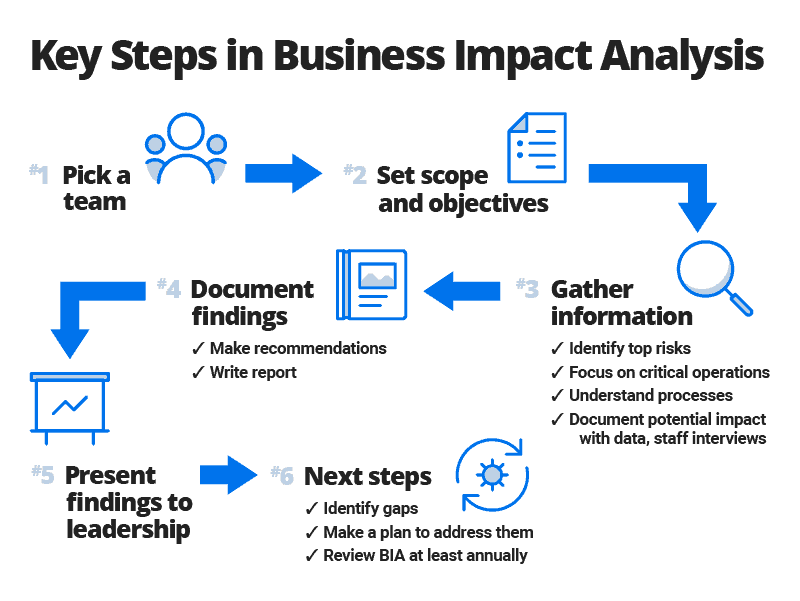
The Business Impact Analysis
Is a collaborative data collection activity. Interviews are conducted with the functional owners and administrators of a business function to understand:
- Services provided by the business function.
- Dependencies that the business function has in order to operate (i.e., facility, people, technology, vendor).
- Recovery requirements of dependencies.
- Alternatives, workarounds, and/or manual processes in the event the dependencies is unavailable or inaccessible.
- Potential risk impact that the University could experience in the event that the business function could not recover and establish continuity within its recovery objective(s).
- Business Impact Analysis data is housed and maintained within the Business Function tab of the Fusion Framework.
The Risk Assessment and Gap Analysis
Consolidates the results of the Business Impact Analysis by prioritizing dependencies based on the criticality of their recovery objectives, and conducting a comparison against current recovery capabilities to determine if a potential recovery gap is present. These results are presented to organizational leadership for review and decision on whether the potential gap is an acceptable risk or should be remediated through additional investments or workarounds. This analysis enables:
- Senior and functional leaders within a campus organization/division collaborate to understand the potential risks that could impact operational continuity in the event of a disaster or significant disruption.
- Transparency between campus entities to identify recovery requirements and dependency recovery capabilities.
- Thoughtful risk management and informed decision making.
- Facilitation of conversations between campus leaders and dependency providers to determine effective solutions for risk remediation.
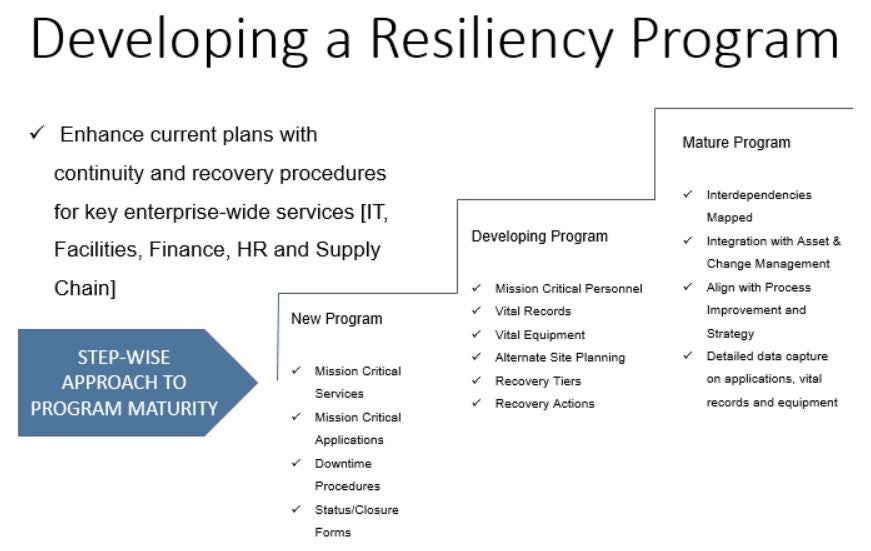
Business Continuity Planning
UCR continuity plans proactively focus on mitigating potential impacts and maintaining operations during a disruption. Business Continuity Planning documents the actions and activities that a business function will execute to establish and sustain continuity of operations at an acceptable level within recovery objective(s) in the event of a disaster or significant business disruption. Plans are designed on an all-hazard approach focusing on four key loss scenarios:
- Loss of Facility
- Loss of People
- Loss of Supplier
- Loss of Technology
An all-hazard approach focuses on the impact of a loss rather than its cause. Business Continuity Plans are developed and maintained within the Fusion Framework.
Plan Exercising and Continuous Improvement
Validates the feasibility of a Plan, identifying opportunities for continuous improvement over time. Exercises can take the form of a simulated event or a live event. A live event is a situation in which the Business Continuity Plan was used in an actual disaster or significant business disruption to the business function. A simulated event is facilitated by DR/BC Services where a business function can exercise a Business Continuity Plan in one of the three ways:
-
Walkthrough: A gathering of the business function team to conduct a detailed review of the Business Continuity Plan, ensuring awareness and understanding of content, roles, and responsibilities
-
Tabletop: A gathering of the business function team to discuss and role-play a disaster or significant business disruption for the purpose of exercising the Business Continuity Plan in a controlled environment
-
Functional: A gathering of the business function team to perform and role play a disaster or significant business disruption for the purpose of exercising the Business Continuity Plan in as real an environment as possible without an actual disaster or significant business disruption occurring
Exercise information and results are maintained within the Fusion Framework.

Recovery
UCR’s ability to remain operational following a disruption is dependent upon its ability to maintain our core mission serving our students, faculty, staff, and the community, and is one of the integral parts of the comprehensive emergency management paradigm under the Recovery phase.